Bring the Organization to the Project
Why I built Square Up around the project-centric organization, and where P.M.I. (Project Management Institute) and the P.M.O. (Project Management Office) fit
Michael T. Dunn, Founder, LaunchPad · November 2026
When someone starts a company in this industry, whether it's a specialty contractor, a subcontractor or a general contractor, they are builders. They take great pride in that: in understanding a contract, discerning the scope, estimating the cost against that scope, presenting it, and then building something for a client.
Somewhere along the way, as companies grow, we lose some of that.
What I've seen over the last two decades is organizations siloing themselves by role and by responsibility. Project managers, less and less, are engaged at the project level. Too many have become comfortable in an administrative role: a paper pusher, a data entry specialist. That evolution has isolated the project, and it has left the superintendent on an island. The same thing has happened with job cost accounting, with administration, with business development, preconstruction, procurement and subcontractor relations. Each of those tasks is part of the project, and each has drifted away from it.
The client never sees our departments. The client experiences one thing: a project delivered well, or poorly. Mission is proven at turnover.
That's why I developed the P.C.O. (Project-Centric Organization), and why I built Square Up to put it to work.
What repeats, and what doesn't
In 2019, I had the opportunity to work with Ed Massey, the CEO of Seawood Builders, a brilliant man. He helped me see what we were always striving for, which was excellence in project delivery, and how elusive it is.
Ed would say: "Michael, there are tasks that go on within a company that are repeated over and over again for every project." Administration. Job cost accounting. Scheduling. Submittal review. Contract review. The variability isn't in those tasks. It's in the execution: the conditions, the circumstances, the people at the project level, day to day and week to week.
His point was crystal clear to me. As a director or VP of operations, you have to step back and understand how those static tasks feed into and support the project. Once you make that determination, everything surrounding the delivery can be sharpened and focused.
That is the whole idea in one sentence. Take the knowledge, the information and the communication inside the organization, and apply it at the project.
The structure we inherited
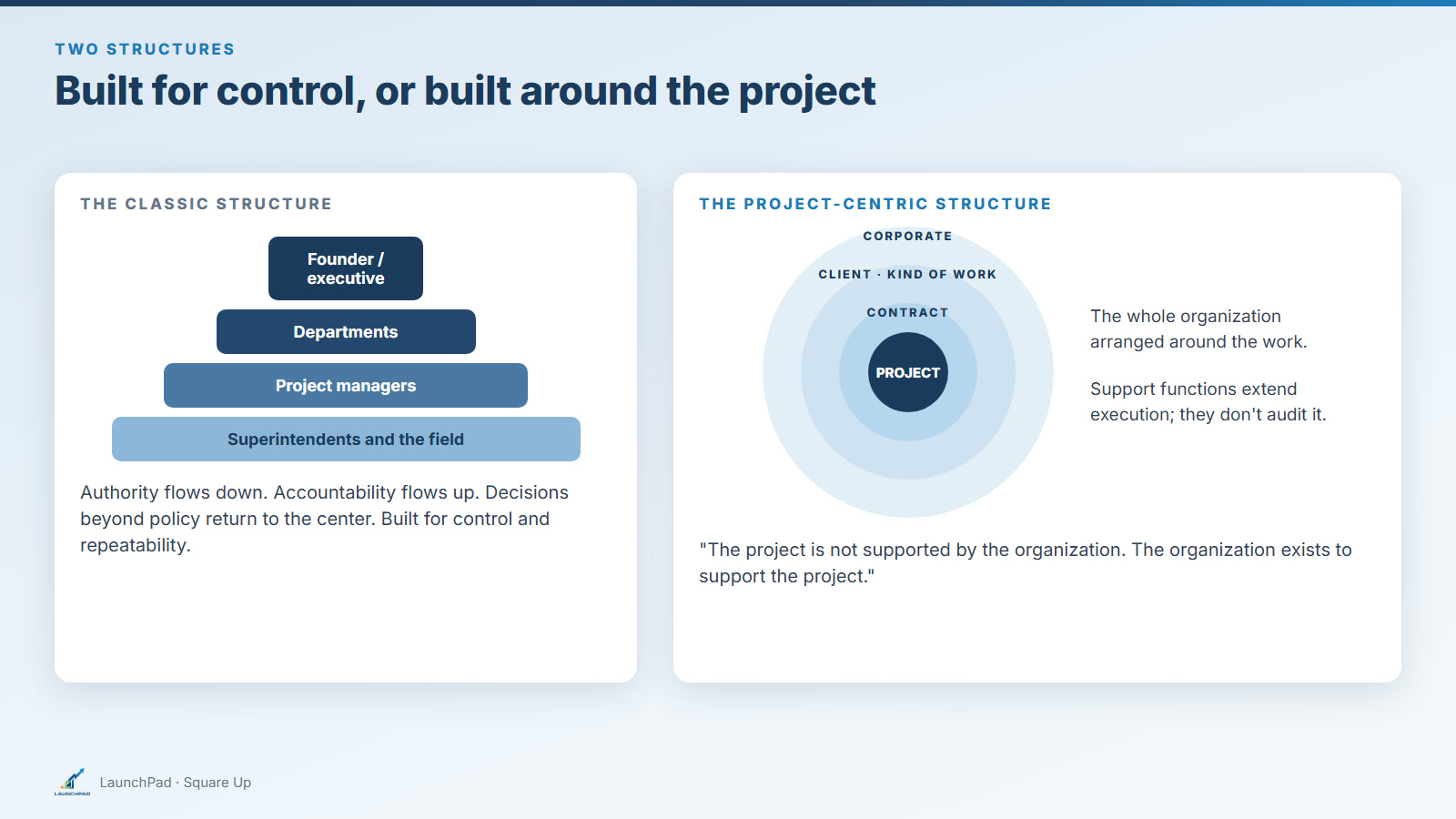
Most of us built our companies the way companies have always been built: a pyramid, with the founder at the top. Authority flows downward. Accountability flows upward. When a decision goes beyond policy, it goes back to the center. As the company grows, the controls grow around the founder.
That structure was designed for control and repeatability. Construction doesn't repeat. Every project is a product built once, under a contract, on a site that changes daily. Henry Ford could remove discretion from his line because the environment allowed it. Construction requires discretion because the environment demands it. The environment isn't noise around the work. It is the work.
Here's what a project-centric response looks like in practice.
It's 9:30 in the morning. Overnight rain has saturated the subgrade, and the concrete placement scheduled for that morning is in question. The drawings are clear. The specification is unambiguous. The contract language is precise. None of it accounts for standing water, delayed deliveries, or a crew already mobilized.
The superintendent walks the site and weighs the options. He understands the means and methods, the sequencing of the trades, and what the weather allows. He also knows the schedule commitments, the quality requirements and the contractual cost of delay. That decision can't wait for a weekly meeting.
Within minutes the project manager is looped in, not to take over, but to interpret the schedule impact and the contractual exposure. Accounting confirms the cost of remobilizing. Procurement checks material lead times. The administrator documents the event and updates the record. No one is "approving" the weather. Everyone is enabling the decision.
The placement is deferred, the sequence is adjusted, and the client is notified with context, not excuses. That isn't centralized authority, and it isn't unbounded autonomy. It's expertise coordinated around the project in real time.
What I learned building delivery units
In 1995 the State of Florida passed legislation allowing municipalities to buy construction through alternative delivery methods. Until then, most local government work was low-bid, stipulated sum, and the results were predictable: overruns, adversarial relationships, claims and litigation.
Construction Management at Risk was a different product. It demanded early collaboration, transparent cost management, preconstruction services and shared accountability. I pursued it deliberately. I studied the delivery models, dissected the RFQs, and read every competitor proposal that was public record.
Over time that pursuit became a delivery unit: project managers, business development, administrators and accounting, organized around one client need and one contract form. It wasn't a department carved out of an org chart. Over eight years it generated more than $200 million in contract revenue, and it did that alongside the hard-bid work that had built the company, on the same systems and standards.
When the market slowed in 2007, we did the same thing again with limited remodels for Walmart, a market you had to prequalify and train for. I pulled eight people from inside the company, invested in their training, and supported them myself through onboarding in Bentonville. Then I watched who could let go of how work "should" be done. Some couldn't; their experience, valuable elsewhere, had become a constraint. Others leaned in. Over two years, a team of two plus superintendents delivered more than $8 million of that work.
Not everyone grows with every opportunity. That isn't a failure of leadership. It's reality. Delivery excellence comes from people who choose to engage deeply with a specific set of constraints, and from a system built to let them succeed.
P.M.I. (Project Management Institute), the P.M.O. (Project Management Office) and the P.C.O. (Project-Centric Organization)
I'll be honest about where I come from. I tend to lean toward the P.M.O. But I believe the best model is the P.C.O., and I want to be fair to all three, because I've learned from all three.
P.M.I. gave our profession its discipline: a shared vocabulary, a body of knowledge, and a credential that opened project management to people who didn't come up through engineering or the trades. Its current standard, the PMBOK Guide (7th edition, 2021), has moved from process groups toward principles, tailoring and the delivery of value. That's a direction I respect.
The P.M.O. gives a company governance across many projects: support, coordination and learning. The research I find most useful (Kutsch, Ward, Hall and Algar, 2015) judges a P.M.O. by what it contributes to results, not by how much it enforces.
The P.C.O. asks a different question: how should the whole company organize itself around each project? It doesn't replace project discipline or a project office. It changes where they work and whom they serve.
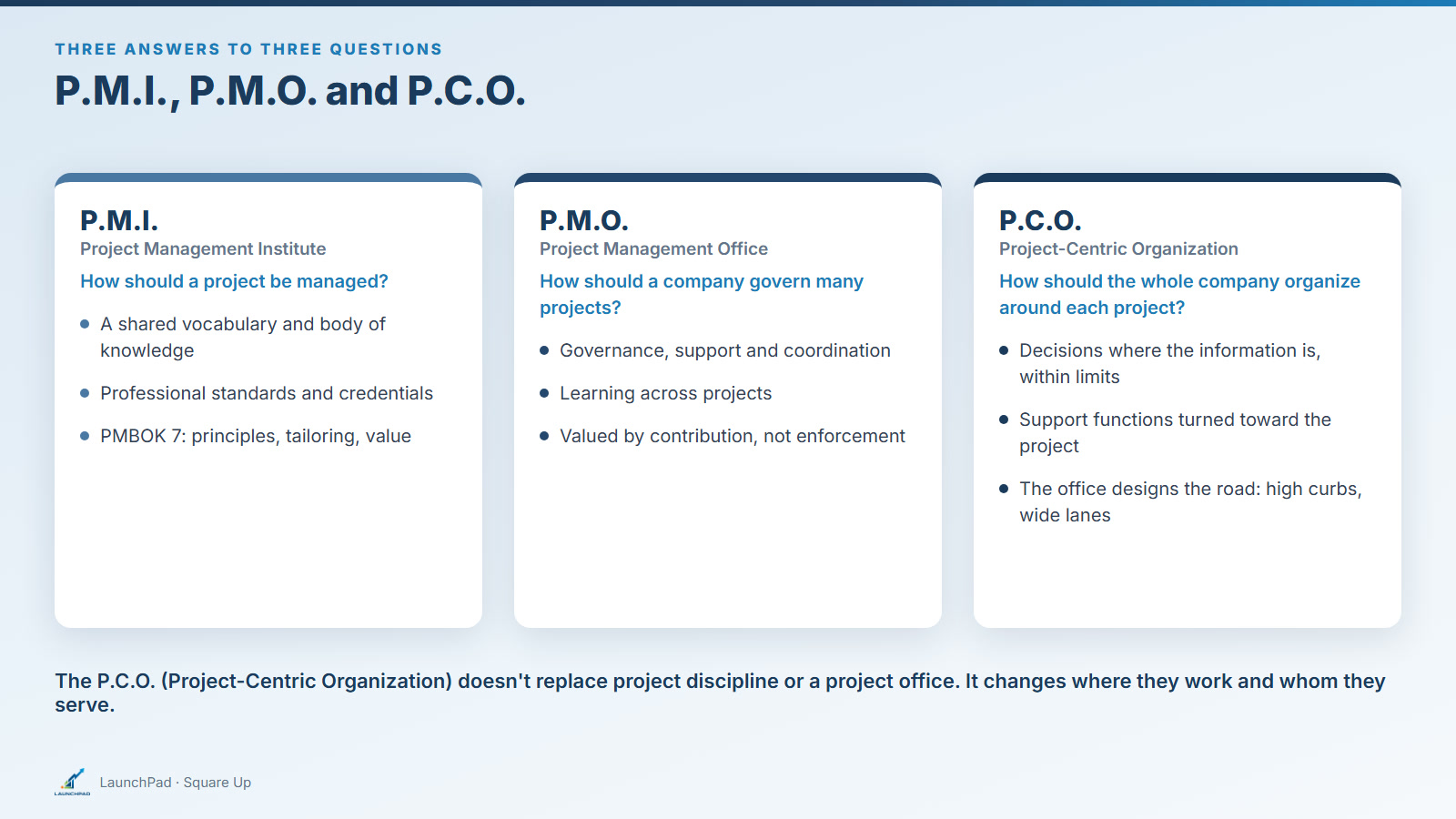
Corey Miller, Chief Operating Officer of JF Petroleum Group, put it best when we talked about the role of a project office: "It's the rules of the road. High curbs, wide lanes." That's how I picture the P.M.O. in a project-centric company. The office designs the road. The curbs are high where the risk is real (contracts, money, safety). The lanes are wide where the project team needs room to use judgment. The project team drives.
It isn't decentralization
The misunderstanding that keeps companies from adopting this model is the belief that it hands decision-making power to the field supervisor. It doesn't. The field supervisor does not replace the project manager, the accountant or the administrator. Each role engages at the point where its expertise directly affects delivery.
Not all decisions carry equal consequence, so autonomy has clear limits. Operational decisions stay local to the project. Contractual authority stays governed. Financial limits are explicit. Strategic risk stays central.
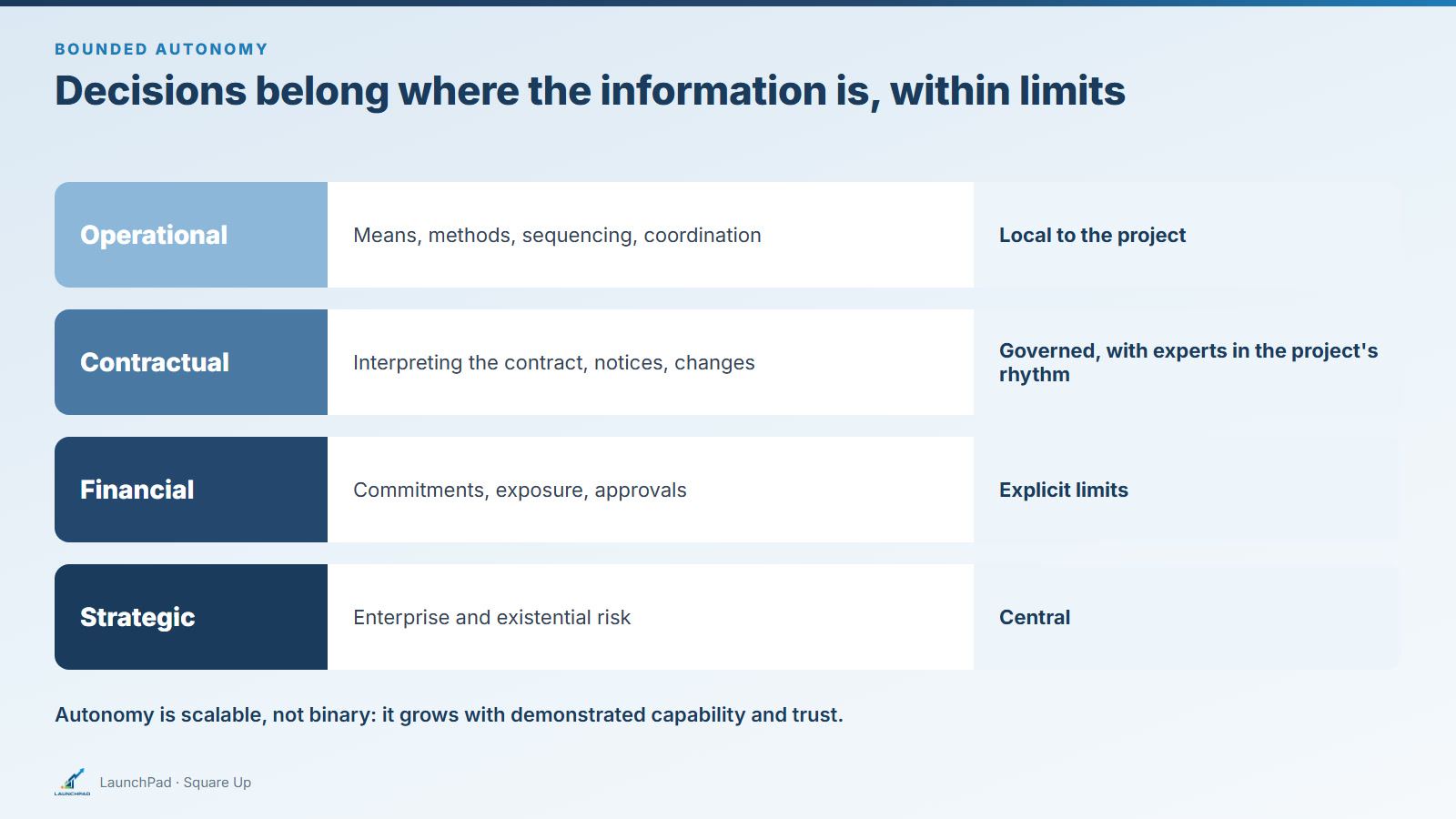
Autonomy isn't granted by title. It's earned through demonstrated competence and judgment, and it can grow or shrink with trust. A project-centric organization treats autonomy as scalable, not binary.
Administration followed authority
When I started building projects, and a business, we didn't talk about "project administration" as its own discipline. There was the project manager, and there was an assistant.
We were deliberate about the pairing. If a PM was strong in the field but weaker at pay applications, written communication or detailed cost tracking, we paired him with an administrator who was strong in exactly those areas. The assistant didn't own the project or the decisions. The assistant extended the PM's reach so execution didn't suffer under paperwork.
Administration followed authority.
Over time, as companies grew, titles multiplied: project coordinator, project administrator, assistant project manager. What had been support slowly became structure. Paperwork acquired owners and processes acquired guardians. Administration stopped being something the PM did with help and became something the organization did to the project. Administration doesn't exist to supervise execution. It exists to reduce resistance to it.
Cost works the same way. Cost doesn't control execution. Execution produces cost. A great builder uses cost as a boundary, not a compass.
The knowledge lives in people
While we were growing the company in Virginia, I hired Thomas McMeekan to lead our estimating. He was methodical and deeply experienced. More than once, after an award, when a bust surfaced or a claim began to form, the questions would drift back toward estimating. Thomas would chuckle and say, almost casually, "That's a field problem."
In principle he was right. Once the contract is signed, the estimate has done its job. But what the estimate carried, and could never fully express, was knowledge: assumptions about productivity, lessons from similar work, where risk was priced carefully and where it wasn't. That knowledge doesn't live in the numbers. It lives in the people who produced them. When it stays trapped there, the field inherits obligation without understanding.
That's the loss I worry about most. According to NCCER, 40% of the construction labor force plans to retire by 2031. At the same time, Associated Builders and Contractors estimated the industry needed to bring in 499,000 new workers in 2026 alone. It's like a high school coach losing the whole senior class after a championship season. You'd better find a way to get that experience into the juniors and sophomores before they're on the field.
We don't help ourselves when we only celebrate the outcome. Company newsletters celebrate the project that closed, the way a school paper reports that the team won on Friday night. They never show the hours of coaching, the drills, the film, the playbook, the adjustments on the sideline, or the second-stringer who stepped in and why it worked. In construction, that's the knowledge that has to be applied at the start of the next job, not admired at the end of the last one.
Excellence is communication
Melvin Conway observed in 1967 that organizations build things that mirror how they communicate. Construction proves it every day. The building reflects how its team shared what it knew: in the drawings, through the trades, from the leadership, and in the conversations on site.
Three kinds of communication carry a project:
- Linear: a directive. "This project requires PPE at all times. See the contract, the corporate safety policy and the OSHA regulation." No reply is needed, but the source has to be clear.
- Interactive: a request. "Attached is the change order request. Please review the cost and, if approved, issue the change order."
- Transactional: face to face. The most common at the project level, and the riskiest for the company.
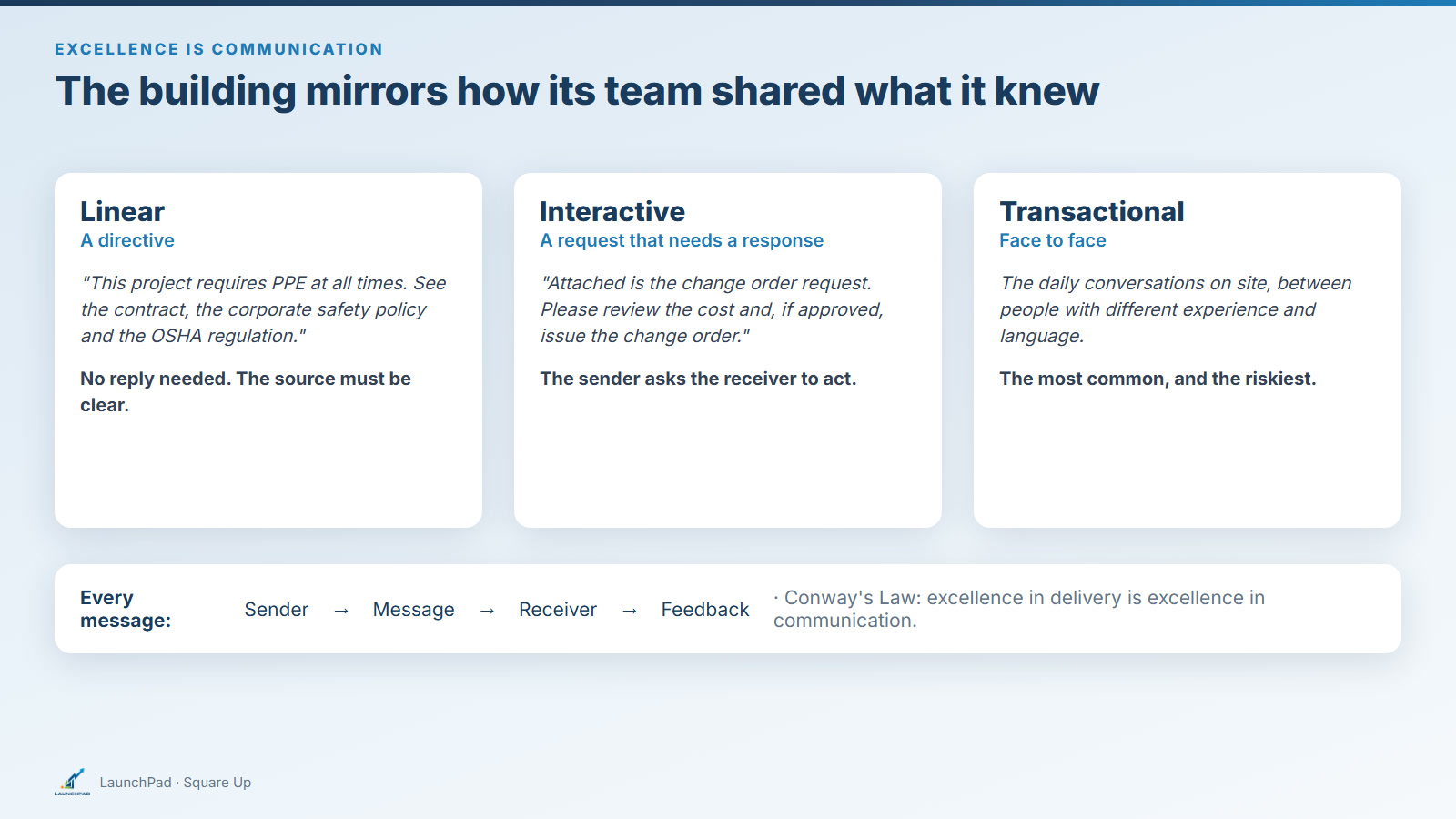
If the goal is excellence in delivery, it runs through excellence in how the organization communicates, from the corporate office to the project and back again.
Why I built Square Up
Every contractor I know has standards. They're in an operations manual, in client requirements, in contracts, and in the heads of the people who built the company. Every contractor I know also has project records, in Procore. What's missing is the connection: getting the right knowledge to the right person on the right job while it can still make a difference.
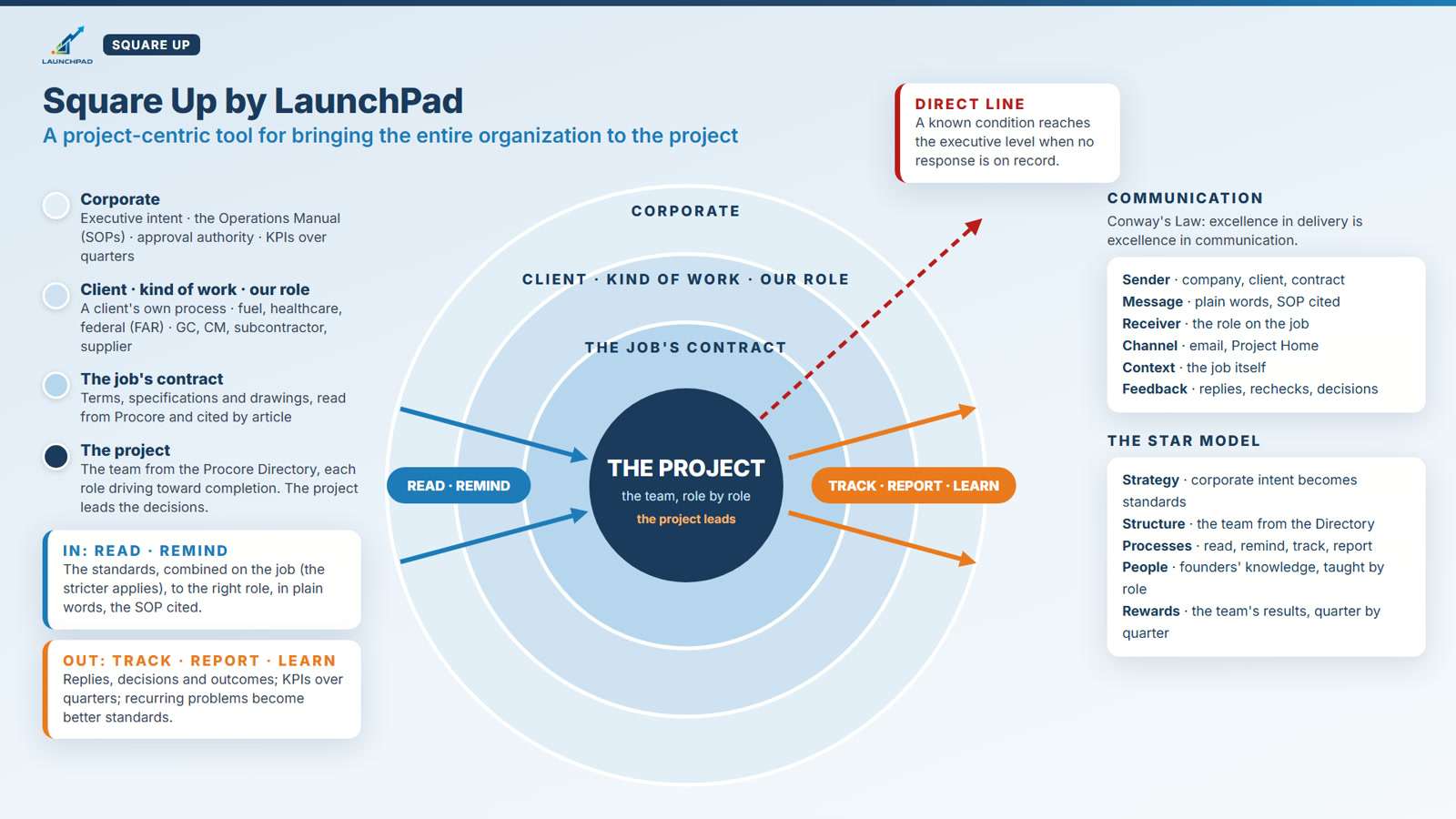
Square Up is the P.C.O. put to work:
- It begins at corporate. Leadership owns the standards and the approval authority. Nothing becomes a standard because an agent suggested it. A person drafts it, an authorized person approves it, and every version is kept.
- It lives at the project. Each job has one home for the whole team. The job's contract, the client's requirements, the standards for that kind of work and the company's SOPs are combined there. Where two of them set the same requirement, the stricter one applies, and the team is always told what the contract requires.
- It speaks to the role, in plain words. A superintendent, a project manager or an administrator can ask in their own words and get the standard that applies, with the source.
- It listens. Replies are recorded and Procore is read again to verify them. A known condition, like a crack in a footing, reaches the executive level when no response is on record.
- It learns. When the same problem keeps showing up, the standard's owner is asked whether the standard or the execution is at fault.
It reads our Procore records and never changes them. It doesn't replace the superintendent, the project manager or the engineer. It gets the superintendent off the island.
The project is not supported by the organization. The organization exists to support the project.
Sources and further reading: Melvin E. Conway, "How Do Committees Invent?" (1968). Jay R. Galbraith, the Star Model of organization design. Project Management Institute, A Guide to the Project Management Body of Knowledge (PMBOK Guide), 7th ed. (2021). Elmar Kutsch, Jonathan Ward, Mark Hall and Joe Algar, "The Contribution of the Project Management Office: A Balanced Scorecard Perspective," Information Systems Management 32(2), 2015. NCCER, as reported by NationalWorld, "What can be done to fix the construction labor shortage" (July 14, 2025). Associated Builders and Contractors, 2025 construction workforce shortage model, as reported by ENR (January 2025). Adapted from the author's forthcoming book on the project-centric organization.
See Square Up on your own projects.
Square Up brings the entire organization to the project.
© 2026 K8 Construction, Inc. All rights reserved.